Magnetostatics
- Biot-Savart’s Law
- Ampere’s Circuit Law-Maxwell’s Equation
- Magnetic Flux Density - Maxwell’s Equation
- Magnetic Scalar and Vector Potentials
- Forces due to magnetic fields
- Magnetic boundary conditions
- Permeability (\(\mu_r\))
- Magnetostatic field is produced by a constant current flow.
Biot-Savart’s Law
- \(dH \propto \frac{Idl \sin \alpha}{R^2}\) where
- \(dH\) = magnetic field intensity at a point P
- \(Idl\) = differential current element
- \(\alpha\) = angle between current element and line joining it to point P
- \(R\) distance between point P and current element
i.e. \(\fbox{$ d\vec{H} = \frac{Id\vec{l} \times \hat{a}_R}{4\pi R^2} = \frac{Id\vec{l} \times \vec{R}}{4\pi R^3} $}\)
- direction of magnetic field determined using right-hand screw rule where thumb represents direction of current, rest of the fingers show direction of field.
- other source elements for surface current density and volume current density are: \(Id\vec{l} \equiv \vec{K}dS \equiv \vec{J}dv\)
H-field for finite length of I carrying wire
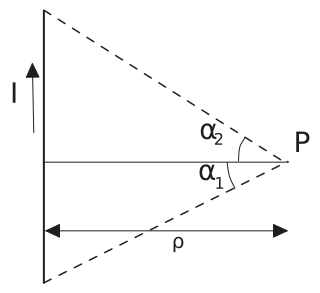
- \[\vec{H} = \frac{I}{4\pi \rho}(\sin\alpha_1 + \sin\alpha_2) \hat{a}_\phi\]
- for semi-infinite wire, \(\alpha_1 = 90^\circ, \alpha_2 = 0^\circ, \vec{H} = \frac{I}{4\pi\rho} \hat{a}_\phi\)
- for infinite wire, \(\alpha_1 = 90^\circ, \alpha_2 = 90^\circ, \vec{H} = \frac{I}{2\pi\rho} \hat{a}_\phi\)
Ampere’s Circuit Law-Maxwell’s Equation
- If \(I_{enc}\) is current enclosed by a closed path, then \(\fbox{$ \oint \vec{H} \cdot d\vec{l} = I_{enc} $}\)
- We have \(\oint \vec{H} \cdot d\vec{l} =\int_s (\nabla \times \vec{H}) \cdot d\vec{S} = I_{enc} = \int_s \vec{J} \cdot d\vec{S}\)
i.e \(\fbox{$ \nabla \times \vec{H} = \vec{J} $}\) - \(\nabla \times \vec{H} = \vec{J} \neq 0\) then field is not conservative
-
Infinite line current \(I\) along z-axis \(\vec{H} = \frac{I}{2\pi\rho}\hat{a}_\phi\) Infinite sheet current with uniform current density \(\vec{K} = K_y \hat{a}_y\) \(\vec{H} = \frac{1}{2}\vec{K} \times \hat{a}_n\)
Magnetic Flux Density - Maxwell’s Equation
- magnetic flux density \(\vec{B}\) similar to \(\vec{D}\)
- \(\fbox{$ \vec{B} = \mu_o \vec{H} $}\) (Webers/square meter) or Teslas
- magnetic flux \(\psi = \int_s \vec{B} \cdot d\vec{S}\) (Webers)
- isolated magnetic poles don’t exist hence \(\fbox{$ \oint_s \vec{B}\cdot d\vec{S} = 0 $}\) i.e. \(\fbox{$ \nabla \cdot \vec{B} = 0 $}\)
- magnetostatic field is not conserved, but magnetic flux is conserved
- magnetic field lines are always continuous
- \(\nabla \cdot \vec{b} = 0\) then field is said to be solenoidal
Magnetic Scalar and Vector Potentials
- Magnetic Scalar Potential \(V_m\) (Amperes) only defined where \(\vec{J} = 0\)
\(\fbox{$ \vec{H} = -\nabla V_m $}\) - vector magnetic potential \(\vec{A}\) (Wb/m) \(\vec{B} = \nabla \times \vec{A}\)
- scalar potential only used in source-free region
Forces due to magnetic fields
- charged particle: \(\vec{F} = Q(\vec{E} + \vec{v} \times \vec{B})\)
- current element: \(d\vec{F} = Id\vec{l} \times \vec{B}\)
Force per unit length between two current carrying conductor is given by \(\fbox{$ \frac{F}{L} = \frac{\mu_o I_1 I_2}{2\pi R} $}\)
Magnetic boundary conditions
- equations used to determine boundary conditions for magnetic field are: \(\oint \vec{B} \cdot d\vec{S} = 0\) and \(\oint \vec{H} \cdot d\vec{l} = I\)
- Given \(K\) is surface current at the boundary, \(\theta_1, \theta_2\) are angle to normal of \(\vec{B}_1, \vec{B}_2\) respectively
- \(\fbox{$ \vec{B}_{1n} = \vec{B}_{2n}$}\) or \(\fbox{$ \mu_1 \vec{H}_{1n} = \mu_2 \vec{H}_{2n}$}\)
- \(\fbox{$ \vec{H}_{1t} - \vec{H}_{2t} = K $}\) or \(\fbox{$ \frac{\vec{B}_{1t}}{\mu_1} - \frac{\vec{B}_{2t}}{\mu_2}$} = K\)
- general case \((\vec{H}_1 - \vec{H}_2) \times \hat{a}_{n12} = \vec{K}\)
- for current free boundary(\(K = 0\)), \(\fbox{$ \frac{\tan\theta_1}{\tan\theta_2} = \frac{\mu_1}{\mu_2} $}\)
Permeability (\(\mu_r\))
Here, external field H, magnetization M, magnetic susceptibility \(\chi\)
- \(B = \mu_o (H + M)\) and \(B = \mu_r \mu_o H\) i.e. \(M = (\mu_r - 1)H\)
- where \(\fbox{$ \chi = \mu_r - 1 $}\)