Electrostatics
- Gauss’s Law - Maxwell’s Equation
- Electric Potential
- Electric field as Gradient of potential - Maxwell’s Equation
- Current and Current density
- Continuity Equation
- Boundary Conditions
- Poisson’s and Laplace’s Equations
- Capacitance
- Extras
Gauss’s Law - Maxwell’s Equation
We have, total outward electric flux \(\psi\), any closed surface \(S\), total charge enclosed \(Q_{enc}\), volume charge density \(\rho_v\), electric flux density \(\vec{D}\)
\[\psi = \oint_S \vec{D} \cdot d\vec{S} = Q_{end} = \int_V \rho_v dV\]Applying divergence theorem, we get \(\nabla \cdot \vec{D} = \rho_v\)
\(\vec{D} = \epsilon_r \epsilon_o \vec{E}\), (units \(C/m^2\))
- Permittivity of free space: \(\epsilon_o = 8.854 \times 10^{-12} \space \text{F/m}\)
- \[k = \frac{1}{4\pi \epsilon_o} \simeq 9 \times 10^9 \space \text{m/F}\]
Application of Gauss’s Law
- Choose Gaussian surface such that \(\vec{D}\) is normal or tangential to the surface and some symmetry exhibited by the charge distribution.
| Charge Source | \(\vec{D}\) | Gaussian surface |
|---|---|---|
| Point | \(\frac{Q}{4\pi r^2}\hat{a_r}\) | Sphere |
| Infinite line (z-axis) | \(\frac{\rho_L}{2\pi \rho}\hat{a_\rho}\) | Cylinder |
| Infinite sheet (xy-plane) | \(\frac{\rho_S}{2}\hat{a_z}\) | Box |
| Uniformly charged sphere (radius \(a\)) | \(\begin{cases}\frac{r}{3}\rho_v \hat{a_r} & 0 \lt r \le a \\ \frac{a^3}{3r^2}\rho_v \hat{a_r} & r \ge a \end{cases}\) | Sphere |
Application of Coulomb’s Law
| source | \(\vec{E}\) |
|---|---|
| On axis of charged ring (xy-plane, radius \(a\)) | \(\frac{Qz}{4\pi \epsilon (z^2+a^2)^{3/2}} \hat{a_z}\) |
| On axis of charged disc (xy-plane, radius \(a\)) | \(\frac{\rho_S}{2\epsilon} \left(1 - \frac{z}{\sqrt{z^2+a^2}} \right) \hat{a_z}\) |
Electric Potential
- Work = (Force component along path) x Distance
- \(\vec{F}=Q\vec{E} \quad\) and \(\quad dW=-\vec{F}\cdot d\vec{l}\)
- \[V_{AB} = \frac{W}{Q} = - \int_A^B\vec{E}\cdot d\vec{l} = V_B - V_A\]
- For closed path where point A = B, \(\oint \vec{E}\cdot d\vec{l} = 0\)
- Equipotential surfaces are always \(\perp^r\) to \(\vec{E}\).
- Potential due to set of point charges, \(V = \frac{1}{4\pi \epsilon} \sum_{k=1}^{N}\frac{Q_k}{\text{abs}(R-R_k) }\)
Electric field as Gradient of potential - Maxwell’s Equation
\[V_{AB} + V_{BA} = 0 \implies \oint_L \vec{E} \cdot d\vec{l} = 0\]Using Stoke’s Theorem, we get \(\quad \nabla \times \vec{E} = 0\)
- defining potential \(V = - \int \vec{E} \cdot d\vec{l}\)
- \[\vec{E} = - \nabla V\]
Electric Dipole
- potential at point P \(V = \frac{Q}{4\pi \epsilon}\left( \frac{1}{R_+} - \frac{1}{R_-}\right)\)
- vector electric dipole moment: \(\vec{p} = Q\vec{d}\) (d from -Q to +Q)
- if point P is very far away (i.e. \(R_+ \approx R_- \approx R\), \(R >> d\)), then \(V = \frac{Qd\cos \theta}{4 \pi\epsilon R^2} = \frac{\vec{p} \cdot \hat{a_R}}{4 \pi\epsilon R^2}\)
- Therefore \(\vec{E} = -\nabla V = \frac{p}{4 \pi\epsilon R^3}(2\cos\theta \hat{a_R} + \sin\theta \hat{a_\theta})\) (V/m)
Energy density in electrostatic field (\(J/m^3\))
- Energy stored for N point charges \(W_E = \frac{1}{2}\sum_{k=1}^{N}Q_kV_k\)
- continuous charge distribution \(W_E = \frac{1}{2}\int_{vol.} \rho_v V dv\)
- \[W_E = \frac{1}{2}\int_{vol.} \vec{D}\cdot\vec{E} \space dv\]
- define energy density as \(w_E = \frac{dW_E}{dv} = \frac{1}{2}\vec{D}\cdot\vec{E} = \frac{1}{2}\epsilon E^2 = \frac{D^2}{@\epsilon}\)
Current and Current density
- \(I = \frac{dQ}{dt}\) and \(\Delta I = J \Delta S\) i.e. total current through a surface \(S\) is \(I = \int_S \vec{J}\cdot \Delta \vec{S}\)
- \(I\) depends on these kinds of current densities:
- Convection current density
- Conduction current density, \(\vec{J} = \rho_v \vec{v_d}\)
- Displacement current density
Ohm’s law
-
\(\vec{J} = \rho_v \vec{v_d} = \frac{ne^2\tau}{m_e}\vec{E} = \sigma\vec{E}\)
where \(\sigma = \frac{ne^2\tau}{m_e}\) is conductivity, \(n\) is number of electrons per unit volume, \(\tau\) is avg. time interval between collisions. -
A perfect conductor(\(\sigma = \infty\)) cannot contain an electrostatic field inside it
- i.e. under static conditions \(E=0, \rho_v =0, V=0\)
- Hence, also called equipotential
- As external electric field is applied, both +ve and -ve charges accumulate on the surface to form induced surface charge and create induced internal field to negate the external field.
- Resistance \(R = \frac{V}{I} = \frac{\int_v \vec{E}\cdot d\vec{l}}{\int_s \sigma\vec{E}\cdot d\vec{S}}\)
- Power = rate of change of energy = force times velocity
\(P = \int_v \rho_vdv\vec{E}\cdot \vec{v}_d = \int_v \vec{E}\cdot \vec{J}\)
This is known as Joule’s Law
Continuity Equation
- derived using principle of conservation of charge
- states that there can be no accumulation of charge at a point
- \(\fbox{$\nabla \cdot \vec{J} = - \frac{\partial\rho_v}{\partial t}$}\) is called continuity of current equation
- Derivation: \(I_{out} = -\frac{dQ_{in}}{dt} = \oint \vec{J}\cdot d\vec{S} = \int \nabla \cdot \vec{J} dv\)
i.e. \(\int \nabla \cdot \vec{J} dv = -\frac{dQ_{in}}{dt} = -\int \frac{\partial\rho_v}{\partial t} dv\) - For steady current, \(\frac{\partial\rho_v}{\partial t} = 0\), which proves Kirchhoff’s current law
- Relaxation time: time taken for interior charge to drop to \(e_{-1}\) (36.8%) of initial value.
\(T_r = \frac{\epsilon}{\sigma}\)
Boundary Conditions
To determine boundary conditions, we use maxwell equations
\(\oint \vec{E}\cdot d\vec{l} = 0\) and \(\oint \vec{D} \cdot d\vec{S} = Q_{end}\)
Also \(\vec{E} = \vec{E}_t + \vec{E}_n\) and \(\vec{D} = \epsilon \vec{E}\)
NOTE: \(E_{n}, E_{t}, D_{n}, D_{t}\) are components, hence scalar.
Dielectric-Dielectric Boundary Condition
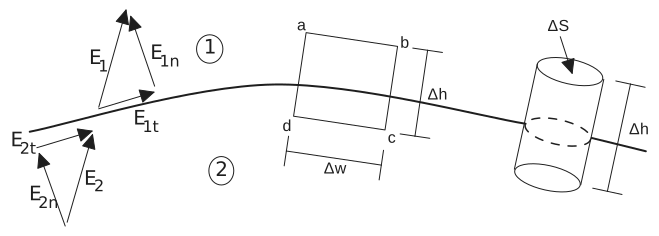
-
We have for the two regions \(\epsilon_1 = \epsilon_o \epsilon_{r1}\) and \(\epsilon_2 = \epsilon_o \epsilon_{r2}\)
Applying \(\oint \vec{E}\cdot d\vec{l} = 0\) to the closed path abcda, and with \(\Delta h \rightarrow 0\) we get
\(E_{1t} \Delta w - E_{2t} \Delta w = 0\)
i.e. \(\fbox{$E_{1t} = E_{2t}$}\) and \(\fbox{$ \frac{D_{1t}}{\epsilon_1} = \frac{D_{2t}}{\epsilon_2}$}\) -
Applying \(\oint \vec{D} \cdot d\vec{S} = Q_{end}\) to the cylindrical gaussian surface, we get
\(D_{1n} \Delta S - D_{2n} \Delta S = \Delta Q = \rho_s \Delta S\)
i.e. \(\fbox{$ D_{1n} - D_{2n} = \rho_s $}\) where \(\rho_s\) is free density placed at the boundary. -
If no free charge exist in the boundary then we get
\(\fbox{$D_{1n} = D_{2n}$}\) and \(\fbox{$ \epsilon_1 E_{1n} = \epsilon_2 E_{2n} $}\) -
If the electric fields make angles \(\theta_1\) and \(\theta_2\) with the normal to the interface then \(\fbox{$\frac{\tan \theta_1}{\tan \theta_2} = \frac{\epsilon_{r1}} {\epsilon_{r2}} $}\)
Conductor-Dielectric Boundary Condition
- Inside a conductor \(\vec{E} = 0\)
- Therefore, \(\fbox{$ E_t = 0, D_t = 0$}\) and \(\fbox{$ D_n = \rho_s, E_n = \frac{\rho_s}{\epsilon} $}\)
Poisson’s and Laplace’s Equations
-
Using Gauss’s Law \(\nabla \cdot \vec{D} = \nabla \cdot \epsilon \vec{E} = \rho_v\) and \(\vec{E} = - \nabla V\)
Poisson’s Equation: \(\fbox{$ \nabla^2 V = - \frac{\rho_v}{\epsilon} $}\)
In charge free region Laplace’s Equation: \(\fbox{$ \nabla^2 V = 0 $}\) -
Above is valid for homogeneous medium, i.e. \(\epsilon\) is constant. For non-homogeneous medium we have \(\nabla \cdot (-\epsilon \nabla V) = \rho_v\)
-
Uniqueness Theorem: if a solution to Laplace’s equation can be found that satisfies the boundary conditions, then the solution is unique.
Capacitance
- must have two (or more) conductors carrying equal but opposite charges
- flux lines leaving one conductor must necessarily terminate at the surface of other
-
pot. diff. between the plates \(V = V_1 - V_2 = - \int^{1}_{2} \vec{E} \cdot d\vec{l}\)
- Define capacitance as \(C = \frac{Q}{V} = \frac{ \epsilon \oint \vec{E} \cdot d\vec{l} }{ \int \vec{E} \cdot d\vec{l}}\) farads(F)
| Type | \(\vec{E}\) | \(V\) | \(C\) |
|---|---|---|---|
| Parallel-plate (plate area = A, plate separation = d) | \(-\frac{Q}{\epsilon A} \hat{a}_x\) | \(\frac{Qd}{ \epsilon A}\) | \(\frac{\epsilon A}{d}\) |
| Coaxial (inner radius = a, outer radius = b, length = L) | \(\frac{Q}{2\pi \epsilon \rho L} \hat{a}_\rho\) | \(\frac{Q}{2\pi \epsilon \rho L} \ln \frac{b}{a}\) | \(\frac{2\pi \epsilon \rho L}{\ln\frac{b}{a}}\) |
| Spherical (inner radius = a, outer radius = b) | \(\frac{Q}{4\pi \epsilon r^2} \hat{a}_r\) | \(\frac{Q}{4\pi \epsilon}\left( \frac{1}{a} - \frac{1}{b} \right)\) | \(\frac{4\pi \epsilon}{\frac{1}{a} - \frac{1}{b} }\) |
- For isolated sphere \((b \rightarrow \infty), C = 4\pi\epsilon a\)
- For series capacitors, \(C = \frac{C_1 C_2}{C_1 + C_2}\)
- For parallel capacitors, \(C = C_1 + C_2\)
Extras
- dipole moment \(\vec{p} = Q\vec{d}\)
- for n dipole moments per unit volume, then \(\vec{p}_{total} = \sum^{n \Delta v}_{i=1}\vec{p}_i\)
- Polarization \(P = \lim_{\Delta v \rightarrow 0} \frac{1}{\Delta v} \vec{p}_{total}\)
- Also \(\fbox{$D = \epsilon_o E + P $}\), \(\fbox{$ P = \chi_e \epsilon_o E $}\) and \(D = \epsilon_r \epsilon_o E\)
- \(\fbox{$ \epsilon_r = \chi_e + 1 $}\), where \(\chi_e\) is electric susceptibility of material.